
अपने मोबाइल को तोड़कर दो अगर अभी तक भी आपने How to make cardboard ai video Prompts वायरल वीडियो नहीं बनाई क्योंकि अभी जो भी ऐसा Cardboard Style Video बना रहा है वह Millions से ला रहा है और आप भी बना सकते हो बताता हूं कैसे Universal Fruit & Vegetable Flower Stamp AI
सबसे पहले Google Flow पर करो और नीचे दिया विडियो Prompt Copy करके Google Flow में Paste कर दो इस प्रांप्ट में अपने [Object Name] एड कर दो जिस पर आपको वीडियो बनाना है और फिर जनरेट पर क्लिक कर दो बस फिर कुछ सेकंड में आपकी Cardboard Style Video रेडी हो जाएगी
अगर आप भी AI Video बनाना या सीखना चाहते हो, तो मैंने आपके लिए एक Ebook Pdf Step by Step AI Video के बारे में बताया है, जो लोग इस Ebook को खरीदना है, तो इस लिंक पर क्लिक करे Buy Now
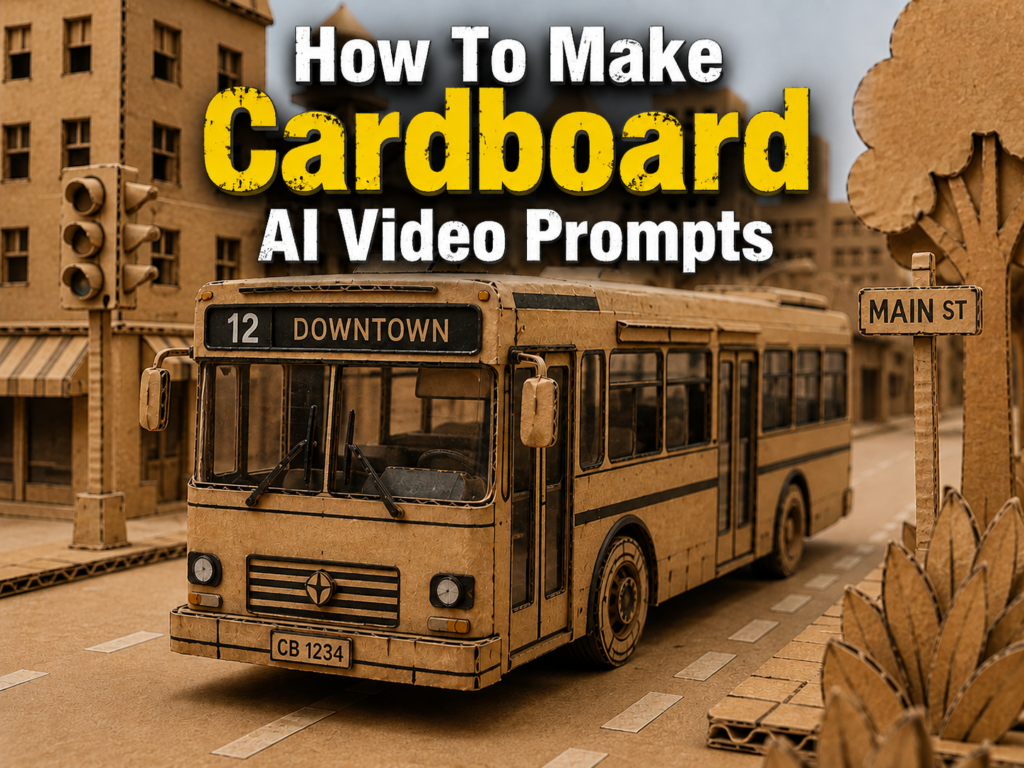
How To Make Realistic Cardboard AI Video Prompts | Best AI Video
OBJECT NAME: [OBJECT NAME] Create a highly realistic, smooth, cinematic 9:16 vertical video featuring [OBJECT NAME], using the uploaded reference video as the primary visual reference for the original concept, composition, framing, subject placement, camera perspective, camera movement, pacing, timing, actions and overall visual style. Recreate the reference as accurately as possible, but transform the entire scene into a realistic handmade cardboard world. The most important requirement is that the result must look like a real physical model built by skilled craftsmen from cardboard and filmed with a real camera, not like CGI, a 3D render, a cartoon, an illustration or a plastic toy. [OBJECT NAME] must be the main subject and must remain clearly recognizable throughout the entire video. Recreate its real-world shape, proportions, structure, important features and functionality, but construct every part of it entirely from cardboard or paperboard. Use realistic cardboard construction techniques such as layered sheets, folded panels, corrugated cardboard, rolled cardboard tubes, stacked pieces, cut-out sections, reinforced joints, overlapping layers and precisely shaped cardboard components. Give every component realistic physical thickness. Cardboard edges, folds, seams, layers, cuts, corrugation and small handmade imperfections should be naturally visible, especially in close or medium shots. The object should look carefully engineered and professionally handcrafted rather than roughly assembled. If the object normally contains metal, glass, plastic, rubber, electronics, concrete or other materials, reinterpret those components using cardboard construction while preserving their recognizable appearance and function. For example, windows can be represented by carefully fitted dark cardboard or paperboard panels, wheels by multiple layered cardboard discs, metal panels by precisely cut cardboard sheets, and mechanical parts by interconnected cardboard pieces. Do not use actual metal, glass, plastic, rubber, concrete or other physical materials anywhere in the miniature. The entire surrounding environment must also be made from cardboard. Every visible object—including buildings, roads, tracks, vehicles, furniture, signs, poles, trees, plants, machines, people or figures, platforms, bridges, walls, pipes, tools, decorations, background structures and tiny props—must be constructed from cardboard or paperboard. Nothing should accidentally appear as a real-world material. The environment should be detailed enough to make the viewer believe that an entire miniature world was physically handcrafted from cardboard. Use layered cardboard architecture, folded surfaces, corrugated structural pieces, cardboard tubes, cut-out windows, miniature panels, paperboard decorations and realistic handmade construction details. Keep the environment clean and professionally crafted while allowing subtle imperfections that naturally occur in a physical handmade model. The scene must have real miniature scale and physical depth. Do not create a flat cardboard illustration. Every object should have believable volume, thickness, weight and spatial relationships. Create realistic foreground, middle-ground and background layers. Objects should naturally overlap one another and cast shadows onto surrounding surfaces. The camera should perceive the scene as a real miniature environment photographed at close range. Maintain realistic perspective and scale relationships between [OBJECT NAME], the environment and smaller props. The cardboard material itself must look physically real. Show subtle paper fibers, corrugated edges, layered construction, tiny cuts, folds, creases, seams, slight dents and natural variations in the cardboard surface. Avoid perfectly smooth computer-generated surfaces. Do not make every piece look identical. Different cardboard components can have slightly different shades and textures while still belonging to the same handmade construction. Preserve the authentic kraft-cardboard appearance, with natural brown, beige, tan, off-white and muted cardboard tones. Additional colours may be used only as realistic paint, printing or paperboard details when necessary to make [OBJECT NAME] recognizable, but the underlying physical construction must always remain cardboard. REALISTIC FUNCTIONAL MOVEMENT The biggest priority after visual realism is natural movement. Do not simply move or slide the cardboard object across the frame. Make [OBJECT NAME] actually function as a miniature physical mechanism. Its movement must feel connected to its construction and environment. Use realistic acceleration, deceleration, inertia, friction, weight and contact. If it has wheels, the wheels should rotate correctly against the surface. If it has doors, doors should move from realistic hinges. If it has tracks, tracks should remain aligned. If it has mechanical arms, levers, rotating components, propellers or other moving parts, each component should move according to believable mechanical relationships. All connected components must maintain their geometry while moving. Cardboard parts should not stretch, melt, bend unnaturally or transform into different objects. The object should maintain consistent proportions, construction details and texture from the first frame to the last. Movement should contain subtle physical vibration where appropriate, making the miniature feel like a real working model rather than an animated digital object. The animation must look like continuous real video footage, not a sequence of generated images. Motion should remain smooth and stable from frame to frame, approximately equivalent to natural 24–30 fps footage. Use realistic motion blur only when caused by actual movement. Maintain consistent object geometry, texture, lighting, shadows and background throughout the shot. Avoid jitter, frame-to-frame flickering, sudden movement, unnatural interpolation, stop-motion movement, teleportation, object duplication or disappearing components. CAMERA & SHOT RECREATION Use the uploaded reference video to reproduce the original camera language as closely as possible. Match the camera height, distance, angle, perspective, lens feel, framing, subject size, composition, depth and movement. If the original camera is completely static, keep the camera completely static. If it slowly pans, tilts, tracks or pushes toward the subject, reproduce that movement with the same approximate speed and direction. Do not add cinematic camera movements that are not present in the reference. Preserve the original video's shot duration, pacing and timing. If the reference contains multiple distinct shots or camera changes, reproduce each camera change accurately while maintaining the cardboard-world concept. If the reference is one continuous shot, keep it as one continuous shot. Camera movement should feel like a real camera filming a physical miniature, with natural optical behaviour rather than artificial CGI movement. Use realistic miniature photography characteristics: natural perspective, subtle depth of field, realistic focus, gentle lens falloff and physically believable motion blur. Do not excessively blur the environment. The cardboard construction details should remain visible and readable. LIGHTING & REAL-WORLD PHOTOGRAPHY Light the scene as if it were a real physical cardboard model being filmed in a studio or realistic indoor environment. Use soft, natural and consistent illumination that reveals the cardboard texture. Create realistic contact shadows underneath objects, cast shadows from structures, subtle ambient occlusion between cardboard layers and natural light falloff across the miniature. Keep lighting direction, intensity and colour temperature consistent throughout the video. Do not allow exposure, shadows or colours to suddenly change between frames. Avoid exaggerated CGI highlights, unrealistic reflections, neon lighting or artificial glow unless the original reference specifically contains such lighting. The final image should have the subtle imperfections of real camera footage: natural exposure, realistic texture detail, believable focus and physical shadows. Do not make the scene excessively polished or digitally perfect. PHYSICAL INTERACTION Whenever [OBJECT NAME] interacts with another part of the environment, make that interaction physically believable. Wheels should contact roads or tracks. Objects should touch surfaces rather than float slightly above them. Moving parts should connect properly. Shadows should follow the object's position. If the object passes behind another cardboard structure, maintain correct depth and occlusion. The cardboard should behave like stiff, lightweight paperboard, not like fabric, rubber or soft plastic. It can support structures and maintain its shape, but small realistic vibrations and slight movement can occur when the object is operating. VISUAL PRIORITY Maintain this priority throughout generation: 1. Real physical cardboard appearance 2. Accurate [OBJECT NAME] design 3. Smooth realistic movement 4. Accurate recreation of reference composition and camera 5. Realistic miniature scale and depth 6. Consistent lighting and materials 7. Detailed handmade construction The viewer should immediately understand what [OBJECT NAME] is while simultaneously believing that it has actually been constructed from cardboard. FINAL VISUAL RESULT The finished video should feel like a viral real-life miniature filmmaking shot of an incredibly sophisticated cardboard creation. It should create the impression that someone physically built [OBJECT NAME], its surrounding environment and all of its functional components from cardboard and somehow made the entire miniature system operate smoothly. The result must feel real, physical, handcrafted, mechanical, detailed and believable. It should NOT feel like: a CGI render an AI animation a cartoon a digital illustration a plastic toy LEGO clay stop motion a game asset a 3D model a flat cardboard illustration It should feel like: “A real camera captured an incredibly detailed cardboard model that actually works.” CONSISTENCY & QUALITY CONTROL Maintain the exact identity of [OBJECT NAME] throughout the video. Do not redesign the object between frames. Keep all cardboard panels, windows, wheels, doors, joints, decorations and structural elements consistent. Do not introduce new materials. Do not randomly add objects. Do not remove important objects. Do not change the environment layout during the shot. Preserve the reference video's original visual rhythm, framing, camera behaviour and action timing while replacing the original physical world with the cardboard interpretation. NEGATIVE PROMPT No CGI appearance, no 3D render, no cartoon, no animation look, no plastic toy, no LEGO, no clay, no metal, no glass, no rubber, no concrete, no fabric, no realistic wood, no digital surfaces, no floating objects, no sliding without physical contact, no morphing, no melting, no stretching, no shape shifting, no object duplication, no disappearing parts, no flickering textures, no flickering geometry, no inconsistent proportions, no warped structures, no broken perspective, no unrealistic physics, no jerky movement, no stop-motion effect, no frame interpolation artifacts, no sudden acceleration, no random camera movement, no unnecessary cuts, no lighting changes, no excessive depth blur, no artificial reflections, no material switching. FINAL INSTRUCTION: Create [OBJECT NAME] as a fully functional, highly detailed, physically believable cardboard construction and reproduce the uploaded reference video's visual presentation as closely as possible. Everything visible must belong to the same realistic handmade cardboard universe. The animation must be smooth, continuous and physically believable, and the final footage must look as though it was genuinely recorded with a real camera in front of a real cardboard miniature—not generated as CGI
- 5 Formulas of Master AI Prompts – मास्टर प्रॉम्प्ट्स के फॉर्मूले
- AI की दुनिया में स्वागत – Welcome to the World of AI
- 99 AI Image & Video Prompts Short Codes | ChatGPT, Google Flow
- Technical Candlestick & Chart Pattern E-Book – Hindi
- 50+ फसलों की खेती की पूरी जानकारी PDF | किसानों के लिए Complete Farming Guide