
Funny Animal Sketch to Video ek amazing AI trend hai, jahan simple pencil sketch ko realistic 3D animated animal mein transform kiya jata hai! 🐒✏️ Is creative concept mein Monkey, Cat, Elephant, Lion aur other animals ko funny eyes, oversized head aur unusual body proportions ke saath design kiya jata hai. AI image aur video prompts ki help se sketch ko lifelike character banayein, jo funny expressions, awkward walking aur cute dancing movements karta hai. Google Flow, Veo aur other AI video tools ke liye perfect! Create entertaining AI animal videos for YouTube Shorts, Instagram Reels aur Facebook Reels. Chatgpt and Claude Prompts
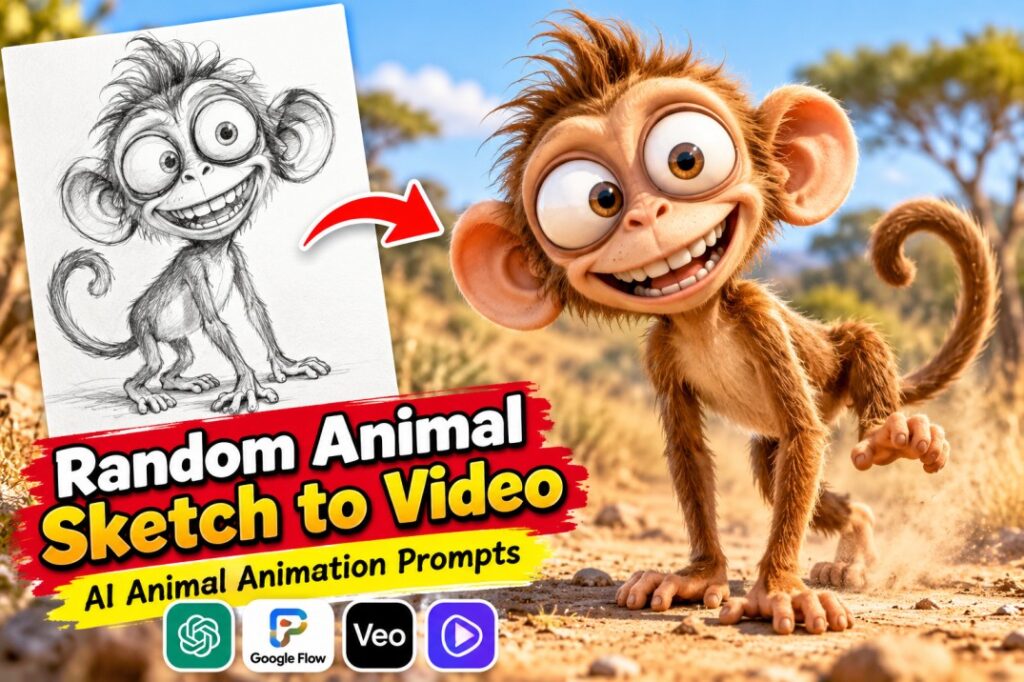
Random Animal Sketch to Video – AI Animal Images Prompts
Image Prompt Create a funny pencil sketch of a [animal name] on plain white paper, designed as a clear character reference for an AI animation. Draw one complete animal with deliberately ridiculous proportions: an oversized head, huge uneven eyes with small pupils, an amusing wide grin, a small chunky body, and thin, awkwardly bent legs with tiny feet appropriate to the animal. Preserve the recognizable features of a [ANIMAL NAME], including its characteristic ears, muzzle or beak, tail, and distinctive markings. Make the expression goofy, friendly, and slightly confused. Show the body in a three-quarter side view, with the face turned toward the viewer. Keep the silhouette easy to understand, every limb clearly connected, and all ears, feet, and the entire tail inside the image. Use the animal’s correct limb count. Leave generous white space around the character. Style: charming amateur graphite drawing with slightly wobbly outlines, loose pencil strokes, light cross-hatching, and a few playful scribbles. Keep the design simple enough to recreate consistently in 3D while retaining its funny imperfections. Use a vertical 9:16 composition, with the animal centred and large. Present the drawing straight-on like a clean paper scan. Black-and-grey pencil only, white background, no scenery, paper edges, hands, text, labels, clothing, accessories, additional animals, colour, watermark, or 3D rendering.
Random Animal Sketch to Video – AI Animal Video Prompts
Video Prompt Create a 10-second vertical 9:16 video in one continuous shot, using the uploaded funny sketch as the exact character-design reference. The animal is a [ANIMAL NAME]. CHARACTER: Bring the sketch to life as a realistically textured 3D [ANIMAL NAME], preserving its funny proportions, unusual body shape, oversized or uneven eyes, facial expression, thin or crooked limbs, tail, and any deliberately strange features. Do not correct the drawing into normal animal anatomy. Use the animal name only to determine appropriate fur, skin, feathers, natural colours, and surface markings. Preserve colours already present in the sketch. Add believable surface detail, moist eyes, natural shading, and physical depth while keeping the sketch’s recognizable design. Do not introduce features absent from the drawing. COMPOSITION: The fully formed animal is visible from the first frame—no transformation sequence. Show its entire body near the centre, with its face oriented toward the viewer and enough space around its feet and tail. Display the uploaded sketch on a small white paper card in the upper-left corner, slightly tilted counterclockwise. Keep the drawing unchanged and clearly visible throughout, without covering the animal’s face. ENVIRONMENT: Match the reference video’s warm, dry savanna setting: sandy beige ground, scattered pebbles, brittle grass, golden vegetation, and distant broad-canopied trees beneath a pale blue sky. Use realistic daylight from the upper-right/front, soft fur highlights, and grounded shadows falling toward the lower-left. Keep the animal sharply detailed against a softly blurred background. Maintain warm ochre, tan, earthy brown, and muted green colours. CAMERA: Maintain a full-body shot from approximately the animal’s upper-body height, with the feet and surrounding ground clearly visible. Use a very gentle lateral camera drift that makes the distant background slide slightly right, subtly revealing more of the animal’s rear-side volume. Keep the animal’s screen position and apparent size almost constant. No cuts, zooms, dramatic orbit, or abrupt reframing. TIMELINE: 0.0–2.0 seconds: Establish the fully realized animal beside its visible sketch. It looks toward the camera with the drawing’s funny expression. Introduce tiny weight shifts, subtle head bobs, and small alternating foot lifts. If it has a tail, add a gentle sway. 2.0–3.5 seconds: The animal opens its mouth slightly wider, exaggerating its existing amusing expression, then returns toward its original grin or mouth shape. Its head bobs naturally with the movement; preserve the original eye size and placement. 3.5–5.5 seconds: Continue a restrained, awkward stepping rhythm within the same small patch of ground. Its body sways gently as its unusual limbs flex. Keep the design stable and each foot contact grounded. 5.5–7.5 seconds: Increase the stepping into a short, playful, springy shuffle. The body makes small upward bounces as the feet alternately lift and land. Each firm landing produces a small tan dust puff that spreads close to the ground. Keep the movement compact and funny, without running or travelling out of frame. 7.5–9.0 seconds: Slow the shuffle into gentle weight shifts. The dust thins and settles while the animal maintains eye contact with the viewer. Let its tail settle naturally if present. 9.0–10.0 seconds: Add one final small head bob and a brief mouth opening, then return toward the original funny expression. End directly on the fully visible animal and unchanged sketch card, with subtle living movement continuing. CONSTRAINTS: Preserve the uploaded sketch’s silhouette, anatomy, limb count, facial asymmetry, and distinctive details throughout. Do not automatically add a barrel torso, spiral legs, tiger stripes, or other features unless they belong to this sketch. No extra limbs, identity changes, new props, additional animals, people, clothing, dialogue, captions, CTA graphics, scene transitions, fade-to-black, or freeze-frame. The result should feel like an absurd hand-drawn animal physically existing in a realistic sunlit environment.